PARIS-BREST-PARIS: A brief history
Paris-Brest-Paris (PBP) has a long history. It is detailed on two Wikipedia pages in a very complete way, but it can be summarized succinctly.
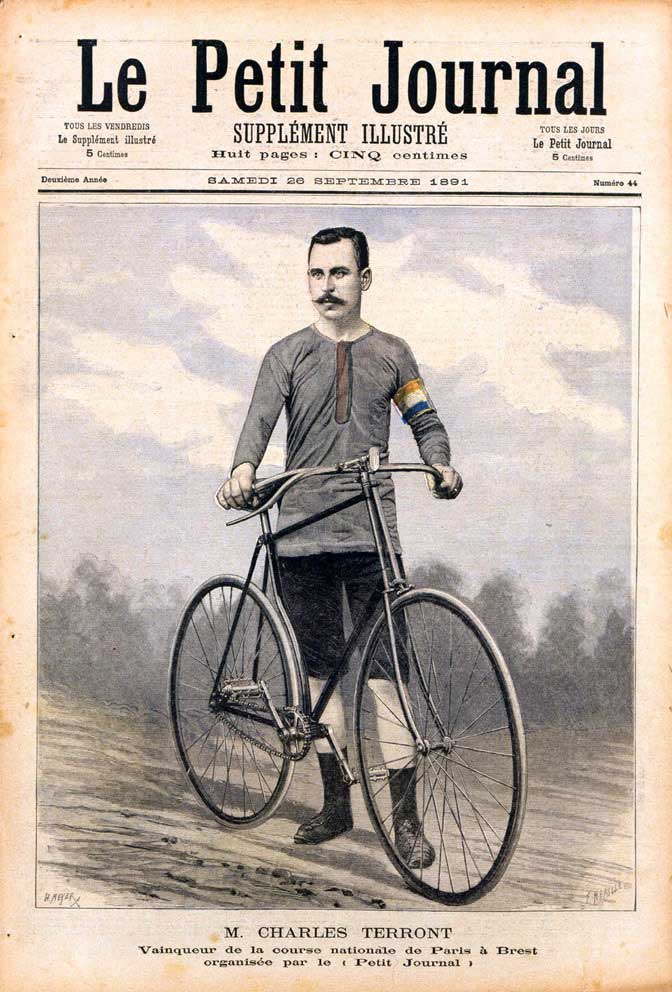
The first PBP was created in 1891 in the form of a velocipede race, called “Paris-Brest and back” open to the pioneers of this nascent sport. Organized by a newspaper called “Le Petit Journal”, its deadline was ten days and it collected about four hundred registrations. Only two hundred cyclists took the start and a hundred saw Paris again in less than ten days.
They are the first homologated on the PBP honour roll, which after the 2023 edition has no less than 26019 names, each of whom has covered the 1200 kilometres at least once within the imposed deadline.
The success of this first PBP, thanks to which Charles TERRONT in 71h37 revealed to the astonished world the extraordinary possibilities of the bicycle, was followed until 1951 by six other editions offered only to speed racers and road tourists. The latter, without coaches and assistance, were the ancestors of our hikers of today.
The Audax Club Parisien, created in 1904, was the first club to organize in May 1921 a 200-kilometer free-paced hikers’ certificate, open to all. Gradually increasing the distance of its brevets, it was in 1931 that the ACP organized the first PBP reserved for hikers. Forty-four participants, including five women, reached the capital in less than 96 hours despite the detestable weather. It was a complete success.
This first edition was followed in 1948, 1951 and every five years, then every four years after 1971 – nineteen editions of Paris-Brest-Paris Randonneurs. They saw the number of participants and especially their geographical origin soar. From 325 participants, almost all exclusively French in 1971, PBP has grown to 6820 registered participants of 70 nationalities during the twentieth edition, in 2023.
The Parisian Audax Club is today the sole maintainer of this monument in the history of cycling and long-distance hiking that is Paris-Brest-Paris. It is a heavy task, in terms of the number of staff and internationalisation, but also in terms of the desire to preserve the spirit that its creator in 1891, Pierre GIFFARD, wanted to give it.
What is this spirit? Of course, it is above all to take up the challenge of going from Paris to Brest and returning on a frail machine, driven by muscle power alone, which is called a bicycle. The challenge is sporting because the time is limited, but it is still wide enough for everyone to associate in their own way with pedalling, the tourism of the regions crossed, the pleasures of the table, the conviviality of the atmosphere, the mutual help between participants, the warmth of volunteer encouragement, etc…
Make no mistake, however, PBP remains a sporting event that deserves respect, even if the stage cities are keen to make it easier for the participants by offering catering, showers, sleeping, repairs, treatments. Therefore, assistance cars, although allowed only to be checked, are not desired. In the same way, the purely competitive spirit is only tolerated, because that is not the end, and the merit of the first to arrive will never be greater than that of the last.
In short, PBP remains an adventure, as in 1891 for the pioneers of cycling, as in 1931 for the first hikers. A modern adventure, open to all, men and women, young and old, neophytes and repeat offenders, which is based on four pillars: sport and friendship, tourism and long distance.